Key takeaways
- A PEO takes over the payroll tax filing, benefits administration, workers' comp, and pretty much all of the HR admin. You retain control of your people and the legal responsibilities that go with that.
- Wage and hour accuracy, I-9 document review, and worker classification remain with you. "We relied on our PEO" has already been rejected as a defense in federal court.
- Several PEO owners have gone to prison for the simple act of holding on to client payroll tax money. Ask your PEO for proof of their tax filings and deposits on a quarterly basis.
- Approximately 42 states register, license, or recognize PEOs. Make sure your PEO is covered in every state where you have employees.
When employees sued Central USA Wireless for unpaid overtime, the company pointed to its PEO. It had sent the paperwork to the PEO, a company witness testified, and hadn't thought about it further. The federal court in Ohio ruled for the employees and awarded liquidated damages, which under the Fair Labor Standards Act can double the amount owed.
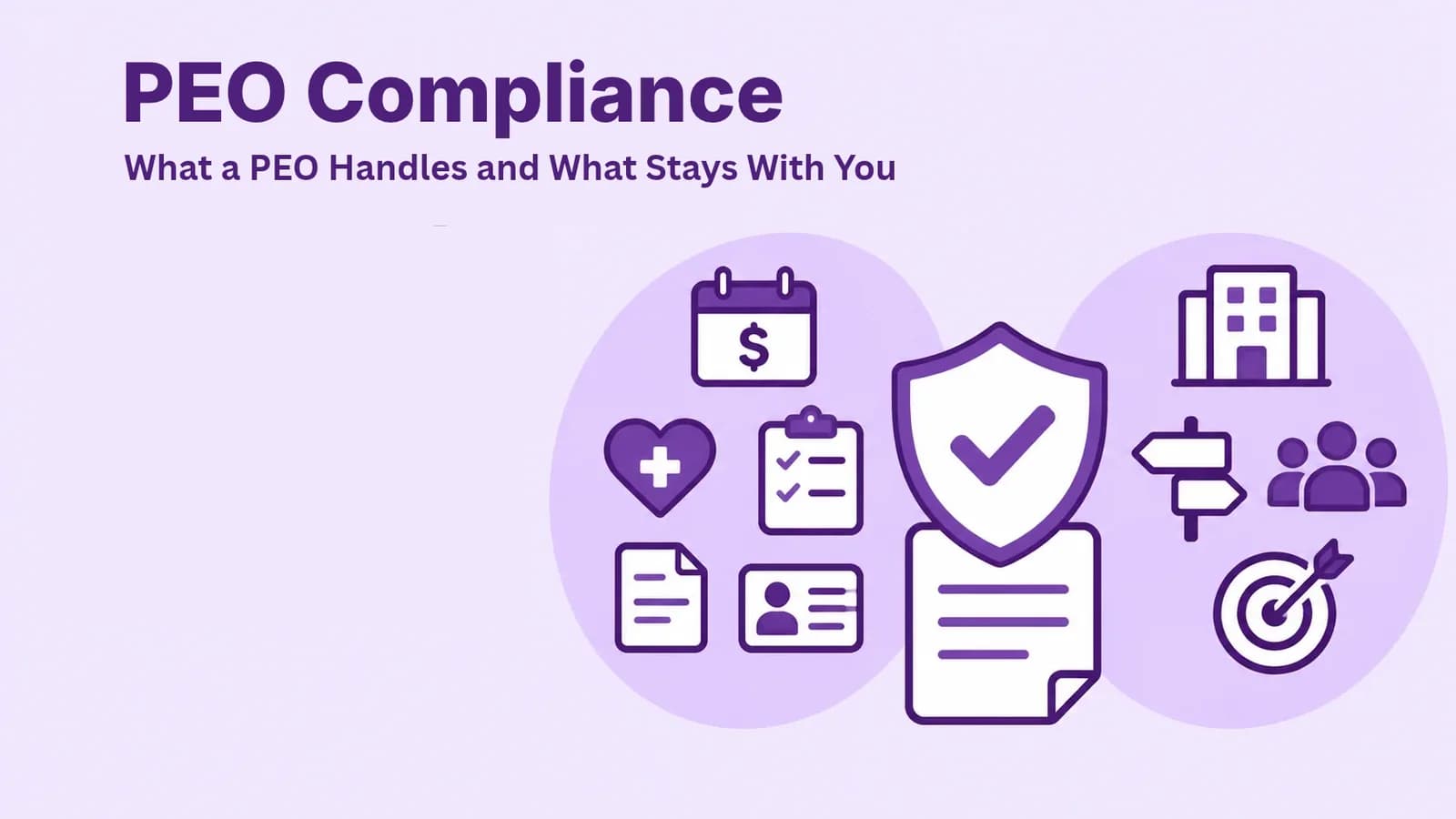
That case highlights a very common misapprehension regarding PEO compliance. A PEO will co-employ your staff and undertake a long list of employer functions, but you're still the one who decides who works, how many hours they work, what they get paid, and whether they are an employee or a contractor. The regulator and the courts will hold you to account for those decisions.
A PEO will generally deal with payroll processing, payroll tax filing (usually under their own tax ID), benefits administration, workers' comp, and HR advice. You're still ultimately responsible for the accuracy of the data you provide them, for worker classification, and for the way your managers treat your employees on a day-to-day basis.
What does a PEO do?
Under co-employment, you and the PEO split the employer responsibilities via a contract known as the Client Service Agreement. The precise split will vary from provider to provider and from state to state, but it will typically be something like this.
Area | PEO typically handles | You still own | Where it breaks |
Payroll and payroll taxes | Calculating pay, withholding, filing, and depositing payroll taxes | Accurate hours, rates, bonuses, and pay changes | A raise entered late means short paychecks and wrong withholding |
Wage and hour rules | Guidance on overtime and minimum wage | Tracking time, approving overtime, setting exempt status | A salaried "exempt" role that fails the duties test |
Worker classification | Guidance and risk flags | The final employee-or-contractor decision | A full-time "contractor" doing core work |
Form I-9 | Electronic forms, storage, reminders | Examining documents for Section 2 on time | A remote hire starts before anyone reviews documents |
Benefits | Plan sponsorship, enrollment, COBRA administration | Plan choices, contribution levels, reporting life events | An employee leaves, and nobody triggers offboarding |
Workers' comp | Coverage through the PEO's policy, claims support | Safe working conditions, prompt injury reports | A late injury report complicates the claim |
Workplace conduct | Handbooks, training, HR advice | Hiring, firing, discipline, promotions, manager behavior | A termination decision can draw a discrimination claim |
Compliance duties a PEO doesn’t take over
Getting wages and hours right
The FLSA will allow an employer to avoid the liquidated damages only by showing that it acted in good faith and had reasonable grounds for its pay practices. In Parks v. Central USA Wireless, the court found that the company's reliance on its PEO compliance "falls far short" of that burden. The usual way that courts will look for that is for some form of advice from a lawyer or a government body.
A PEO runs your payroll. If an employee is incorrectly classified as exempt or their overtime hours never get to the timesheet, that error will go out in every paycheck until it's picked up.
Reviewing Form I-9 documents
USCIS treats the client as an employer for I-9 purposes, and DHS can fine them. In the majority of cases, someone at your company will be the one to check the new hire's ID and work authorization documents. If you're setting this up for a remote workforce, then you'll need to appoint an authorized representative prior to the employee's first day.
Deciding who is an employee
Lots of states will apply their own tests on top of the federal one. A PEO can flag a particularly risky contractor arrangement, but the decision as to whether or not you continue to pay that person on a 1099 is yours.
How do the PEO laws and regulations vary from state to state?
There is no single federal license that covers PEOs. The PEO laws are state by state and, according to NAPEO, around 42 states have some form of registration, recognition, or licensing. Where there is a license, it is mandatory, and having just one worksite employee in a state will usually trigger the PEO's obligation.
Some PEO regulations also allow for third-party accreditation. Indiana, for instance, issues a certified registration to PEOs that have been approved by the Employer Services Assurance Corporation (ESAC).
Before you hire your very first employee in a new state, you must confirm that your PEO is licensed or registered there. Most state agencies will have a lookup list.
What should you be asking a PEO before you sign?
- Which of the duties are under the client services agreement as regards us and which as regards you? Just ask for the answer line by line.
- Are you licensed or registered in every state where we have (or intend to have) employees?
- How are you going to show us each quarter that the payroll taxes have been filed and paid?
- Who completes Section 2 of the Form I-9 for remote hires?
- How do you flag classification risk prior to it becoming a liability?
- What happens to our payroll records and benefits data if we just walk away?
Your CFO will be looking at the deposit evidence and the exit terms. Your Head of People will be looking at the I-9 and the classification answers.
Build the compliance layer before you need it
Most founders are looking for a PEO after something has gone wrong, really. It's usually the first hire in a new state, it's a benefits deadline, it's a payroll error. Getting clean records for five people is a lot quicker than trying to get clean records for fifty.
Niural is an AI-native PEO, built for companies that want that foundation from the first hire. EMMA, Niural's AI layer, validates payroll before the run, flags missing rate changes, and flags potential misclassification risk. That means several of the failure points in the table above surface before money moves, and your team still reviews and approves every run.
The money you set aside for payroll also works for you. Niural PEO clients' payroll float in Niural Wallet earns cash rewards*, so working capital doesn't sit idle between pay runs.
When you hire outside the U.S., Niural adds global payroll and Employer of Record (EOR) hiring in 150+ countries. Niural supports your company from first hire through to global scale on one platform.
Get your side of the agreement right
A PEO can do a lot of the admin work for you, but the decisions that give rise to legal risk are yours. Good PEO compliance is all about three things: get the data right, take the decisions that are yours, and ensure that your PEO is doing its bit.
Book a demo to see how Niural deals with the PEO side and how EMMA can help you pick up issues on yours.
Other related articles:
Top 5 Compliance Mistakes Financial Leaders Can Eliminate with a PEO Partner
1099 vs W-2 Classification Rules
Complete Guide to PEO Renewal
Top 8 PEO Myths
PEO vs ASO
PEO vs EOR
Frequently Asked Questions
What does a PEO take responsibility for?
A PEO will typically deal with payroll, file and pay the payroll taxes, administer the benefits, provide the workers' comp coverage, and give HR advice. The exact split is set out in the client service agreement.
Is our company liable if the PEO we use makes a payroll error?
Often yes. Liability will depend on your agreement and the applicable law, but courts have on more than one occasion found clients liable for wage and hour violations even where a PEO was running the payroll.
Does a PEO determine whether a worker is an employee or a contractor?
No, a PEO can advise and highlight the risk, but the classification decision and the ramifications of that decision are still with your company.
Do PEOs need a state license?
In many states, yes. Some 42 states register, license, or recognize PEOs, and where there is licensing, it is mandatory.
How do I know if my PEO is paying the payroll taxes?
Ask for your filed returns and deposit confirmations each quarter and check any tax notice that comes to your company.
Who handles the workers' comp under a PEO?
The PEO will normally provide the coverage under their policy, subject to the rules of the state. You're still responsible for the safety of your employees and for reporting injuries as and when they occur.
Does a PEO carry out terminations?
A PEO advises on terminations and processes final pay and benefits changes. The decision, and any claim that follows, sits with you.
Can a PEO help with multi-state hiring?
Absolutely. They can deal with state registrations, state withholding, and unemployment insurance accounts. You just need to let them know where each employee is going to work.
What should a Client Service Agreement include?
A clear division of duties, licensing of representations, tax deposit reporting, indemnification of terms, and exit provisions in respect of your data and records.
Disclaimer: *Niural is a financial technology company and is not a bank. Banking services are provided by i3 Bank, Member FDIC.
This article is for informational purposes only and does not constitute legal, tax, payroll, or compliance advice. Requirements vary by state and change over time. Consult qualified advisors about your specific situation.