Key takeaways
- A PEO lets a small company offer medical, dental, vision, life, disability, a 401(k), pre-tax accounts, and more.
- You pay two things: your share of insurance premiums and the PEO's admin fee, usually billed per employee per month.
- Total premiums for employer health coverage average $9,804 a year for single coverage and $28,303 for family coverage (KFF, 2026).
- Workers at small firms (under 200 employees) pay $2,847 more toward family coverage than large-firm workers, so your contribution strategy affects hiring.
A nine-person fintech startup in Denver is closing its first senior engineer. On the offer call, the candidate asks about the health plan, and the founder has nothing to describe. Buying group insurance for nine people means few options and a lot of paperwork, so many founders bring the team into a professional employer organization's (PEO) sponsored group plans instead.
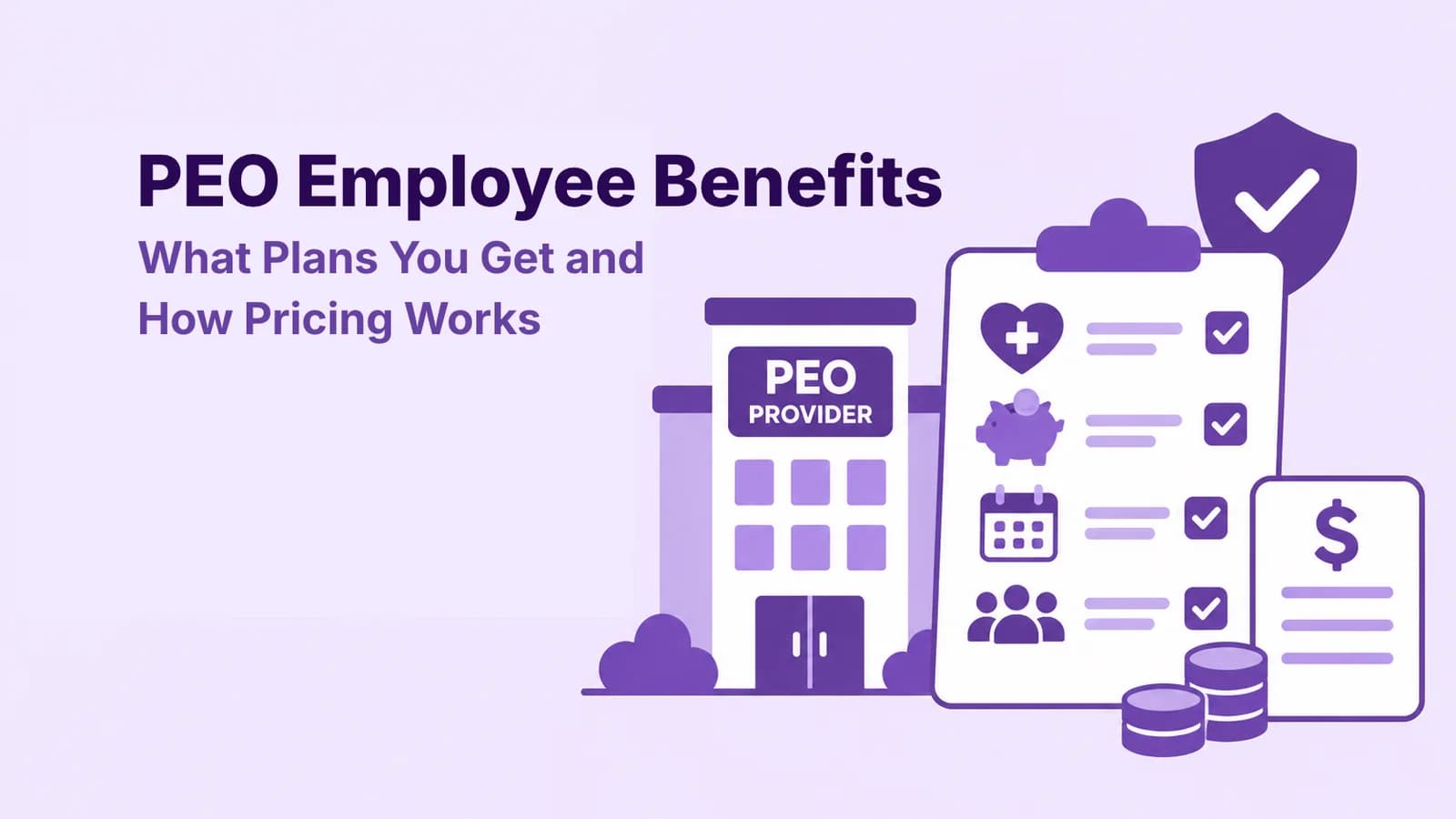
PEO employee benefits usually include medical, dental, and vision insurance, life and disability coverage, a 401(k), and pre-tax accounts such as an HSA, FSA, or commuter benefits. Some PEOs add supplemental coverage or an employee assistance program (EAP). Your employees enroll in PEO-sponsored plans under co-employment, and you pay your share of the premiums plus the PEO's administrative fee.
What plans can you offer through a PEO?
Most professional employer organization benefits fall into three groups: health coverage, income protection, and tax-advantaged accounts. Some PEOs also offer supplemental insurance or an EAP. You pick from the PEO's menu and decide how much of each premium the company pays.
Plan | What it covers | What you decide |
Medical | Doctor visits, hospital care, prescriptions | Plan options offered and your share of the premium |
Dental | Cleanings, fillings, major dental work | Whether to offer it and whether you contribute |
Vision | Eye exams, glasses, contacts | Whether to offer it and whether you contribute |
Life insurance | Payment to beneficiaries if an employee dies | Coverage amount the company pays for |
Disability (short- and long-term) | Partial income replacement during illness or injury | Company-paid or employee-paid |
Supplemental (accident, critical illness, hospital indemnity) | Cash payments after a covered accident, diagnosis, or hospital stay | Whether to offer it; usually employee-paid |
401(k) | Retirement savings through payroll | Whether to match, and how much |
HSA | Pre-tax savings for medical costs; requires enrollment in an HSA-qualified high-deductible plan | Whether to offer an HSA-qualified plan and add an employer contribution |
Health care FSA | Pre-tax money for medical costs; only the limited-purpose version (dental and vision) can pair with an HSA | Whether to offer it, and which version |
Dependent care FSA | Pre-tax money for child care and other dependent care | Whether to offer it |
HRA | Employer-funded reimbursement for qualified medical costs | How much the company funds |
Commuter benefits | Pre-tax transit and parking | Whether to offer it |
EAP | Short-term counseling and referrals | Whether your PEO offers one |
Health coverage: medical, dental, and vision
Medical is the plan candidates ask about first, and it's where PEO health insurance matters most, because a small team gets access to the plan types large employers offer. Nationally, 50% of covered workers are in a PPO, 29% are in an HSA-qualified high-deductible plan, and 12% are in an HMO, according to KFF's 2026 Employer Health Benefits Survey.
A 40-person software company with staff in Austin, Denver, and Brooklyn needs one plan that works in all three cities, so ask whether the network covers every state where you employ people. Niural's Aetna master medical plan, for example, enrolls employees in every state except Hawaii.
Income protection: life and disability
Life and disability coverage cost far less than medical. A common setup is a company-paid base level of life coverage, with employees able to buy more through payroll.
Tax-advantaged accounts: 401(k), HSA, FSA, HRA, and commuter
Among businesses with fewer than 10 employees, PEO clients' employees participate in employer retirement plans at more than three times the rate of employees at comparable businesses that don't use a PEO, according to NAPEO research. The 2026 employee contribution limit for a 401(k) is $24,500.
HSA limits are $4,400 for self-only coverage and $8,750 for family coverage in 2026, rising to $4,500 and $9,000 in 2027. An employee can contribute to an HSA only while enrolled in an HSA-qualified high-deductible plan, and can't also use a general-purpose health care FSA. A limited-purpose FSA, which covers dental and vision costs, can sit alongside the HSA. A dependent care FSA covers a different expense, child and dependent care, so employees can use it with either account.
A 15-person team mostly under 35 might make an HSA-qualified plan its main option and seed each account so employees start the plan year with money toward the deductible.
An HRA works the other way around: only the company funds it, and you set the reimbursement rules within IRS limits.
Commuter benefits let employees pay for transit and parking before taxes, up to $340 a month each in 2026.
What does health coverage cost in 2026?
Total premiums for employer health coverage average $9,804 a year for single coverage and $28,303 for family coverage, both up 5% from 2025, according to KFF. Workers contribute an average of $1,672 toward single coverage and $7,471 toward family coverage, and employers pay the rest.
Workers at firms with fewer than 200 employees pay $9,687 a year toward family coverage, versus $6,840 at larger firms. They also face higher deductibles, averaging $2,624 for single coverage compared with $1,772 at large firms.
KFF also reports that 2027 forecasts point to premium increases approaching double digits, so budget for that at your next renewal.
How does PEO pricing work?
Pricing for PEO employee benefits comes in two layers. Read them separately on every quote.
Layer 1: Insurance premiums. The PEO rates them on its pooled group, and you split them with employees based on the contribution strategy you choose. Premiums generally change at renewal but may also be adjusted during the plan year under applicable plan and contractual terms. The renewal date follows the plan year, which varies by PEO and plan, so ask before you sign.
Layer 2: The PEO's administrative fee. This pays for payroll, tax filings, benefits administration, compliance support, and HR services. Most PEOs bill it per employee per month, though some charge a percentage of payroll.
When you compare quotes, ask each PEO:
- What does the administrative fee include, and what costs extra?
- When does the plan year start, and when is open enrollment?
- How did premiums for our group's plans change at the last two renewals?
- Which states does the medical plan network cover?
- What notice do we need to give if we leave, and what happens to employee coverage?
How much should you pay as the employer?
Your contribution sets what employees see on their pay stubs. On average, workers pay 18% of the single premium and 27% of the family premium. At small firms, the family share rises to 37%, compared with 25% at large firms.
Small firms are also far more likely to cover the full single premium. KFF found that 29% of covered workers at small firms are in such plans, compared with 5% at large firms.
Most companies use one of three approaches:
- Fully paid single coverage. The company covers 100% of the employee's own premium, and employees pay to add dependents.
- Percentage split. The company pays a fixed share, such as 80% for employees and 60% for dependents.
- Flat dollar amount. The company contributes a set amount each month, and employees choose a plan and pay the difference.
Consider a CFO at a 70-person Series B company with employees in six states. Fully paid single coverage costs more but gives recruiters a simple line for every offer letter. A percentage split costs less and scales more predictably. Model both before renewal.
What happens to benefits when you hire outside the U.S.?
A PEO covers U.S. W-2 employees only. When that Denver fintech hires its first engineer in Portugal, it needs an employer of record (EOR) in that country, or its own local entity.
Benefits abroad follow local law, usually statutory social security contributions and mandated leave, often alongside a public healthcare system. You can add private supplemental coverage, but each country sets the baseline.
What does an AI-native PEO like Niural add?
Niural is an AI-native PEO, and the case for it starts at your first hire. Every enrollment, deduction, and employer contribution has to land in the right paycheck, in the right state, on time. Build that infrastructure early, because rebuilding it at 50 employees means re-enrolling everyone and migrating payroll history mid-growth.
Niural's plan menu goes beyond the Aetna master plan. Clients can also choose level-funded plans from Angle Health and Arlo, or Kaiser Open Market plans in California, Michigan, and North Carolina. Guardian supplemental coverage adds critical illness, hospital indemnity, and accident insurance, and WEX administers HSA, health care FSA, dependent care FSA, HRA, and commuter accounts. The master medical plan year runs April 1 to March 31, with open enrollment in Q1.
Niural's AI layer, EMMA, helps identify potential payroll discrepancies, including missing rate changes and deduction issues, before payroll is processed. Your team still approves each run.
Eligible cash balances held in Niural Wallet can earn cash rewards, subject to program terms.
And when that Portugal hire comes, you don't need a second vendor. Niural runs U.S. PEO and EOR in 150+ countries on one platform.
The right PEO employee benefits package helps you close candidates now. The platform behind it should still fit when your team spans states and countries.
Other related articles
How to Save on Benefits With a PEO
PEO Benefits: 7 Advantages for Growing Businesses
Complete Guide to PEO Renewal
Group vs. Individual Health Plans
Payroll Deductions Explained
Fringe Benefits Guide
1099 vs. W-2 Classification Rules
Frequently Asked Questions
What benefits does a PEO usually offer?
Medical, dental, vision, life, disability, a 401(k), and pre-tax accounts such as an HSA, FSA, or commuter benefits. Some PEOs add supplemental coverage or an EAP. The menu varies by PEO and state.
Can a very small company get health insurance through a PEO?
Usually, yes. Many PEOs accept companies with only a few employees, but minimums vary, so confirm eligibility first.
Can I choose which plans my team gets?
Yes, you choose which plans to offer and how much the company contributes. Employees then pick their plan and coverage tier.
Are PEO health plans ACA-compliant?
PEO group health plans are generally built to meet Affordable Care Act requirements. Your own ACA obligations, such as the employer mandate at 50 or more full-time-equivalent employees, still apply.
Does a PEO handle COBRA?
Most PEOs administer COBRA continuation coverage for their sponsored plans, including the required notices. Confirm this in your service agreement.
Can employees have both an HSA and an FSA?
Only certain combinations. An HSA can pair with a limited-purpose FSA (dental and vision) and a dependent care FSA, but not with a general-purpose health care FSA.
Can part-time employees get benefits?
It depends on the plan's eligibility rules, which often set a minimum number of weekly hours. Ask the PEO what applies.
What happens to benefits if we leave the PEO?
Employees move to new plans, and deductibles and out-of-pocket totals may reset. Time any switch to your renewal date to limit disruption.
Can I offer different contributions to different employees?
Within limits. You can set classes such as full-time and part-time, but nondiscrimination rules restrict favoring highly paid employees. Check with a benefits advisor.
When can employees enroll?
New hires enroll during their eligibility window. Everyone else enrolls at open enrollment, which runs before each plan year starts, or after a qualifying life event. Calendar-year plans usually hold open enrollment in November and December. Niural's master medical plan runs April 1 to March 31, so its open enrollment falls in Q1.
Do PEO benefits cover employees outside the U.S.?
No, international employees need an EOR or a local entity, and their benefits follow local law.
How do Niural's cash rewards work?
Eligible payroll float held in Niural Wallet can earn cash rewards. Cash rewards are subject to eligibility and terms.
Disclaimer: Niural is a financial technology company, not a bank. Banking services are provided by i3 Bank, Member FDIC. Cash rewards are subject to eligibility and terms.
This article is for informational purposes only and does not constitute legal, tax, or benefits advice. Plan availability, eligibility, and contribution limits vary; confirm details with a qualified advisor.
Insurance products are offered through Niural Benefits One LLC d/b/a Niural Insurance Services, where licensed, subject to applicable availability and eligibility requirements.