Key takeaways
- A PEO co-employs your team and takes care of payroll, benefits, and compliance as a single package. An HRO will do the HR work you select, and your company remains the sole employer.
- The two models differ most in the employment relationship, benefits, buying power, and how much of the HR stack you still have to run yourself.
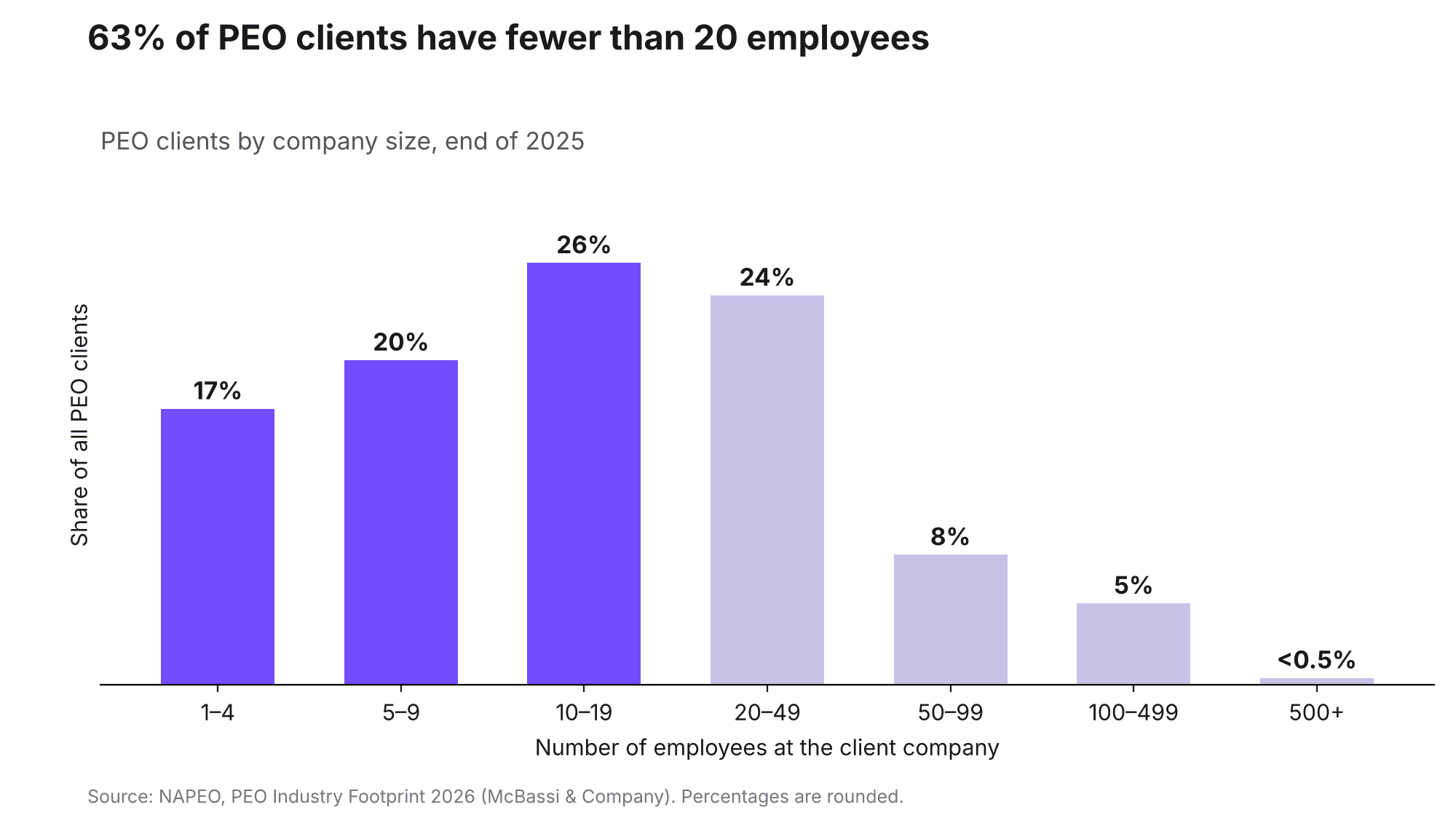
- The vast majority of PEO clients are small. NAPEO's 2026 data shows that 63% of PEO clients have fewer than 20 employees, so it's essentially a decision that's being made in the very first few hires.
Your first offer letter is signed. You need a payroll account, state tax regs, workers' comp, and an answer to the "what are the benefits?" question from every candidate within a week.
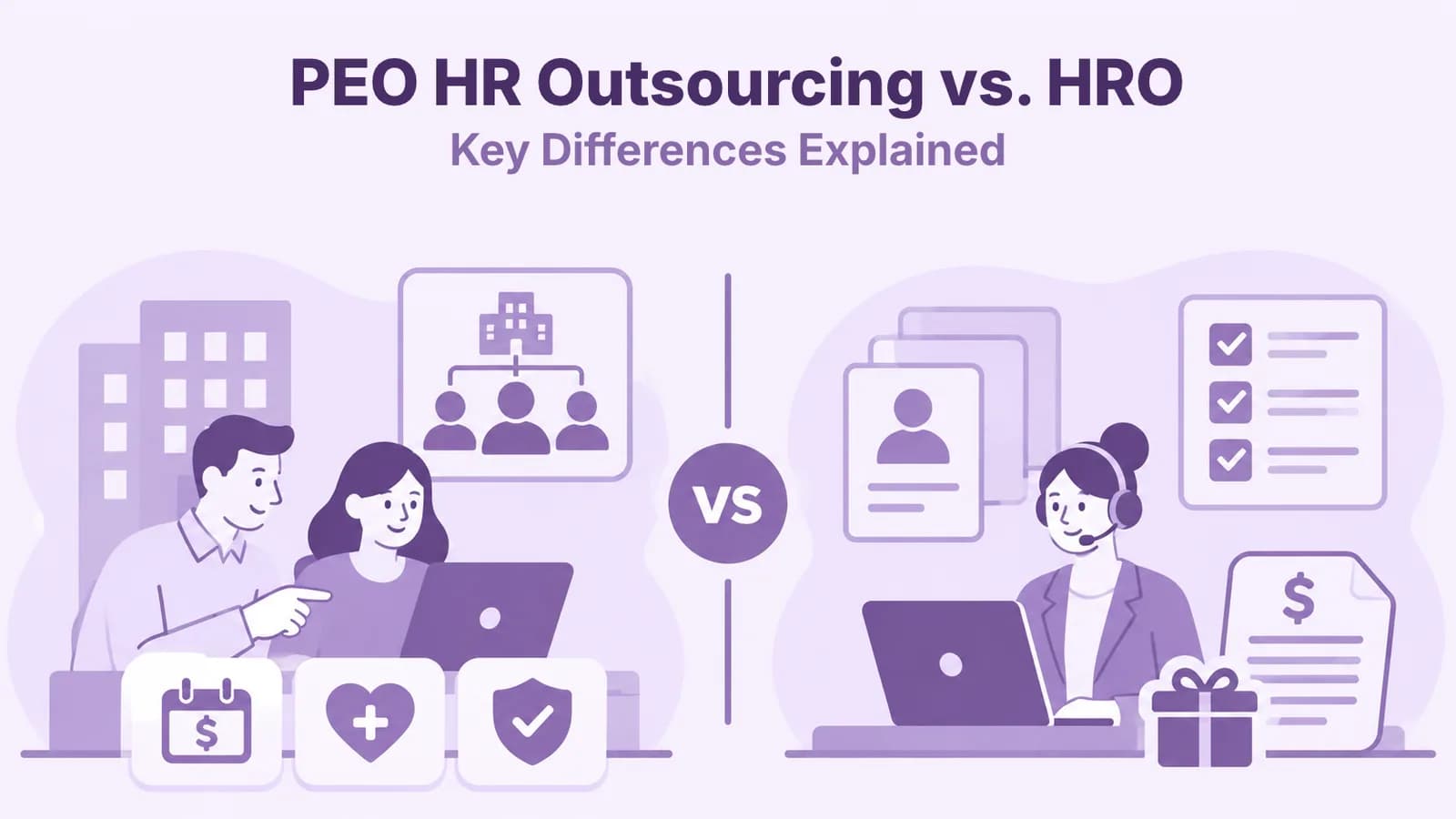
That's the point at which most founders start to consider the two options for handing the work off. Deciding between a PEO vs. HRO is really about who is the employer when you're dealing with payroll, taxes, and benefits, and how much of the stack you still do yourself.
What's the difference between a PEO and an HRO?
Both models take the HR work out of your hands. The difference is in the relationship they create with your people.
What a PEO takes on
PEO HR outsourcing is done via co-employment. You sign a client service agreement, and the PEO becomes a co-employer of your people. You retain full control of the business as to who you hire, what they do, how much you pay them, and who gets promoted. The PEO takes on the employer admin work as a result (typically).
- Running payroll and filing payroll taxes
- Sponsoring group health, dental, vision, and retirement plans that your employees join
- Providing workers' compensation coverage
- Supporting compliance with federal and state employment rules, handbooks, and required notices
- Onboarding and offboarding paperwork
As a PEO takes employees from a number of client companies and pools them into its own benefit plans, a 5-person startup can offer the same benefits as a 500-person company.
What an HRO takes on
An HRO is a vendor. You buy the services you want (payroll, benefits, recruiting, HR consultancy, etc.) and pay for those. Your company remains the sole employer of record. You pick your own insurers or broker, you register in each state yourself, and you decide which of the services you want to do in-house.
That flexibility is the big attraction. The downside is that you're managing several providers and the employer obligations remain with you.
How do PEOs stack up against HROs?
PEO | HRO | |
Employment relationship | Co-employment. The PEO and your company share certain employer responsibilities. | No co-employment. Your company is the sole employer. |
Scope | Bundled: payroll, taxes, benefits, workers' comp, compliance support, HR admin | À la carte: you pick individual services |
Benefits | Access to the PEO's pooled group plans | You buy plans yourself, usually through a broker |
Pricing model | Typically a percentage of payroll or a per-employee-per-month fee | Priced per service used |
Control | You run the business. The PEO runs the employer administration. | You keep full control and full responsibility. |
Internal HR needed | Little to none at small headcounts | Usually an internal HR lead to coordinate vendors |
Typical fit | Startups and small to mid-sized companies, often under 100 employees | Larger companies with an HR team and custom needs |
Leaving | Requires moving benefits, payroll, and tax accounts to a new setup | Can swap one vendor at a time |
What happens when an outsourced provider fails?
Founders will, of course, compare PEOs and HROs on features and price. The real issue is what happens to your obligations if the provider goes under.
In September 2019, MyPayrollHR (a payroll company based in Clifton Park, NY) closed down as its banks froze its accounts. In August 2019 alone, the NY AG reported that over 800 employers had paid out over $28 million in payroll, which the owner had diverted for his own use. Thousands of employees went without their pay. Owner Michael Mann was sentenced to 12 years in federal prison and ordered to pay $101 million in restitution.
The employers in that case were still owing their employees their wages. New York subsequently passed a law requiring its Department of Financial Services to look into the payroll servicing industry as a result of the collapse.
The lesson is applicable to any outsourced setup. In any PEO versus HRO assessment you do, ask yourself where your payroll cash sits between the funding and the payday and how quickly you'd know if anything went wrong. Before you sign up with any provider, you need to have very clear answers to those two questions.
- Who has the money between the day you send it and the day the employees get paid?
- Can you see the payment and tax remittance status in real time or only in a monthly report?
- Does the provider operate its own payment rails or route the funds through a number of third parties?
- What happens to your data and your benefits if you leave?
How do the benefits differ between the two models?
Benefits are where you see the benefits of the PEO's scale most clearly. NAPEO reports that, of businesses with 10-49 employees, 52% of those using a PEO provide a retirement plan, as opposed to just 23% of those that aren't using a PEO.
That gap is more important than it used to be, as some states now mandate that small employers provide retirement savings. In California, employers with one to four employees who do not have a qualified retirement plan in place were required to register for the state's CalSavers program by 31st December 2025. Employers who fail to meet their deadline will be subject to a penalty of $250 per eligible employee, which increases to $500 after 180 days. Having a qualified plan (such as a 401(k)) in place will, of course, exempt the employer.
A founder in SF with two W-2 employees already has a retirement decision to make. One option is a PEO 401(k). With an HRO, you'd select and set up your own plan provider.
When does an HRO make more sense than a PEO?
The PEO vs HRO choice favors an HRO in a few clear situations:
- You already have an HR team that wants to run the benefits strategy and employee relations in-house.
- You want to select your own insurance carriers and plan designs, or you've moved beyond the pooled plans.
- You only need one function covered (e.g., recruitment or payroll processing).
- Your company is big enough that co-employment adds very little, and you'd rather manage each vendor individually.
If none of that sounds like you and you're a founder doing early hires with no dedicated HR person, then a PEO will generally cover more ground with less effort.
Why should founders be making this call at hire one?
The PEO market is all about small companies. NAPEO's PEO Industry Footprint 2026 shows that at the end of 2025 there were 502 PEOs serving 5.4m worksite employees across 233,000 client businesses. The average client had 23.2 employees.
What an AI-native PEO changes
Niural is an AI-native PEO (Professional Employer Organization) built for founders who want to set up their employment infrastructure once and then just let it grow with the company. There are three things that set it apart.
- AI checks the work prior to any money moving. Niural runs its own payroll via its own tax engine and payment rails. EMMA (Niural's AI layer) checks the work prior to the run, picks up on any missing rate changes, and flags any potential misclassification risk. Your team still reviews and approves every run.
- Your working balance earns cash rewards. With most providers, your payroll funds sit in limbo between the day you fund them and the day your employees get paid. With Niural PEO clients, the payroll is funded via the Niural Wallet, and that working balance earns cash rewards* rather than just sitting there. You also have visibility of where the money is and when each payment settles.
- One platform from first hire to global. You can start with a single U.S. employee on Niural PEO, add employees in other states, hire via Niural's Employer of Record (EOR) in 150+ countries, run your global payroll, and pay out contractors all on the same platform. Your records, your approvals, and your payment history all remain in one place, so expansion doesn't mean you have to go and add more vendors.
Five questions to settle before you sign
Use these to pressure-test any provider, HRO vs PEO:
- Who is the employer? Get the employment relationship in writing (and set out clearly what each party's responsibilities are).
- Where is the money? Who has the payroll funds, for how long, and what can you see during the period that it's in transit?
- What happens at your next milestone? Find out how they deal with your first hire in a new state, your first international hire, and your first contractor.
- What does 'leaving' look like? How do your benefit plans, your payroll history, and your tax accounts move if you do leave?
- What does the AI actually do? If they're telling you it's 'AI-powered,' then you need to find out exactly what it does. What steps does it go through? What does it flag? Who actually approves the result?
The bottom line
The PEO vs HRO decision is really down to where you are at the moment. If you've got an HR team and are looking at buying services individually, then an HRO is the way to go. If you're a founder in the early days of your business, making your first few hires, and you want payroll, benefits, and compliance all in one package, then a PEO is the better option. You need to pick one that can grow with you, as switching becomes increasingly difficult with every hire.
Ready to set up your employment infrastructure once? Check out the Niural PEO.
Other related articles:
Complete Guide to PEO Renewal
Top 5 Compliance Mistakes Financial Leaders Can Eliminate with a PEO Partner
1099 vs W-2 Classification Rules
Top 8 PEO Myths
PEO vs ASO
PEO vs EOR
Frequently Asked Questions
What's the main difference between a PEO and an HRO?
A PEO enters into a co-employment arrangement with your business and provides you with payroll, benefits, workers' comp, and compliance. An HRO will sell you individual HR services, and you remain the sole employer.
Is a PEO a form of HR outsourcing?
Yes, a PEO is one form of HR outsourcing. The difference between it and a standard HRO is co-employment and the provision of bundled benefits.
Does a PEO take over my company?
No, you still hire, you still manage, you still set the pay, and you still run the business. The PEO deals with the employer admin (payroll, benefits, compliance, etc.).
Is a PEO or an HRO cheaper?
It's dependent on what you're after. An HRO will be cheaper if you're only after one or two services. A PEO will provide you with a whole range of services and the ability to pool benefits buying, which will in turn reduce your cost for those equivalent plans if you were to buy them individually. NAPEO cites a 27% ROI from PEO cost savings alone.
How are PEOs priced?
PEOs typically take either a percentage of total payroll or a flat fee per employee per month. Benefit premiums are generally billed separately.
How are HROs priced?
HROs typically charge on a per-service basis (e.g., a fee per payroll run, a fee per employee for benefits administration, a fee per hire for recruitment).
Can I get better benefits via a PEO?
Often yes. PEOs pool their employees across clients so that a small company can access group plans which would be very difficult to get on its own.
Can a PEO help us to hire outside the U.S.?
A standard PEO covers U.S. employees. If you want to hire overseas without setting up a local entity, then you need an Employer of Record (EOR). Niural provides both PEO and EOR on one platform with EOR coverage in over 150 countries.
What's the difference between an HRO and an ASO?
An administrative services organization (ASO) provides HR administration without co-employment, similar to an HRO, but usually as a bundled package rather than individual services. Your company stays the employer of record.
How hard is it to switch from a PEO later?
Switching means moving benefit plans, payroll history, and tax accounts. It's manageable but gets more involved as headcount grows, which is why many founders choose a provider that can scale with them.
What does "AI-native PEO" mean?
It means AI is built into the payroll, benefits, and compliance workflows rather than added on top. At Niural, EMMA validates payroll before the run, flags missing rate changes, and flags potential misclassification risk.
Disclaimer: This article is for informational purposes only and does not constitute legal, tax, benefits, or financial advice. Employment, tax, and benefits rules vary by state and change over time. Consult qualified advisors about your specific situation.
* Niural is a financial technology company and is not a bank. Banking services are provided by i3 Bank, Member FDIC.