Key takeaways
- An international PEO is another term for an Employer of Record (EOR), i.e., a provider who will legally employ your hire abroad via their local entity, and you will be the one to manage the person.
- A U.S. PEO co-employs people in the US. It can't put anyone on the payroll in Brazil or Portugal.
- Local pay rules change the budget. A €3,000 per month hire in Portugal comes to about €51,975 a year before benefits and fees (not €36,000).
- The majority of companies will use an EOR until such a time as there are enough people in that country to warrant setting up their own entity.
You've found the engineer you're after in São Paulo. The offer is all ready. Your company has a Delaware C-corp, a U.S. PEO, and no legal presence in Brazil. You can't run her through U.S. payroll, and it would take months to get a Brazilian company registered.
That's what a global PEO company solves. The provider takes on your hire via their own entity in Brazil, handles the local payroll and compliance, and invoices you on a monthly basis. You still pick the person, you still set the work, and you still manage the relationship.
In KPMG's 2025 Global Mobility Benchmarking Report, surveying over 400 organizations, almost 37% expect cross-border remote working arrangements to grow over the next 12-18 months. KPMG states that cross-border remote working has "now become a strategic consideration for many organizations".
Is an international PEO the same as a standard PEO?
They are very different indeed. A U.S. PEO operates on a co-employment basis. You and the PEO both employ your U.S. staff. The PEO takes care of the payroll tax, benefits and HR admin, and you do the business. Co-employment is a U.S. structure for a company that has U.S. operations.
An international PEO is the sole legal employer in the other country via its own local entity. Your company will have a service agreement with the provider, and the provider will have the local employment contract with your hire. That's why it's also referred to as an Employer of Record. There's no such thing as co-employment in most countries, so the EOR model is the one that works overseas.
U.S. PEO | International PEO (EOR) | Your own foreign entity | |
Legal employer | You and the PEO (co-employment) | The EOR's local entity | Your subsidiary |
Where it works | United States | Countries the EOR covers | The country you register in |
Entity needed in that country | Yes, a U.S. business | No | Yes, you set it up |
Local payroll, tax, and filings | PEO runs them | EOR runs them | You or a local payroll provider |
Speed to first hire | Fast | Fast, if the EOR covers the country | Slow: registration, bank, tax, and payroll accounts first |
Best fit | U.S. teams | First hires in a new country | Countries where you're building a large team |
How does an Employer of Record work exactly, step by step?
Most global PEO services follow the same sequence:
- You pick the hire and agree on the salary, title, and start date.
- The EOR drafts a contract that meets local law, including notice periods, statutory leave, and mandatory benefits.
- The EOR takes on the employee, gathers their tax ID, bank details, and right to work.
- Each month, the EOR runs the payroll in local currency, withholds income tax, pays the employer's social contributions, and files with the local authorities.
- You pay the payroll and the EOR's fee, and you manage the employee's work exactly as you would any other member of your team.
Hiring decisions, performance, pay, and the day-to-day running of the business all remain with you. The legal employment relationship and the associated local compliance are handled by the EOR.
What does an EOR do that founders often overlook?
Founders will typically budget for international hires the way they do for U.S. hires, i.e., annual salary divided by 12. That doesn't work in quite a few countries.
Brazil. Under Law No. 4,090 of 1962, employees get a 13th salary each year. The first installment is due by 30th November and the second by 20th December. If you were hired in Brazil this year, then that first payment is about a month away.
Portugal. Salary is paid 14 times a year, with an additional month prior to the summer holidays and one at Christmas. Employers also pay social security at 23.75% on top of gross pay.
For a €3,000-a-month offer, the math looks like this:
That's 44% more than the US-style budget. A good global PEO will build those payments into the payroll calendar and the monthly invoice so you don't get a December obligation as a surprise.
Why not just hire them as a contractor?
Contractor agreements are the quicker way to get an agreement signed, and for genuine freelance work they're the right way to go. The problem arises when you have a 'contractor' working set hours, using your tools and doing the core work for one company. In most jurisdictions, that would be deemed employment regardless of what the contract says.
Spain is a perfect example of how steep that gap can become. The Spanish labor ministry fined Glovo just over €79m in 2022 for classifying around 10k riders as self-employed. They then fined it a further €57m in 2023. In 2025, the Spanish Social Security was demanding €450m in back contributions and fines, and Glovo responded by moving 14k riders onto employee status.
Your startup isn't a delivery platform, but the regulator will still ask the same question of your engineer in Madrid: who's in control of the work?
The second risk lands on corporate tax. If someone works for you from another country on a regular basis, that country may decide your company has a permanent establishment there and owes local corporate tax. In November 2025, the OECD updated its guidance on remote work: working from one location for at least half of total working time over 12 months may indicate a fixed place of business, though that alone doesn't decide it. When a permanent establishment arises without planning, Fieldfisher's tax team notes that authorities "may assess back taxes, penalties and interest."
An EOR gives the employment relationship a proper local home. It doesn't resolve all the tax issues, though, so if someone overseas is signing contracts or selling on your behalf, you'll need to bring in a tax advisor.
When would you set up your own entity?
An EOR charges a fee per employee per month. An entity carries fixed costs instead: registration, local accounting, annual filings, and often a local director. Once a country has enough people, the fixed costs win.
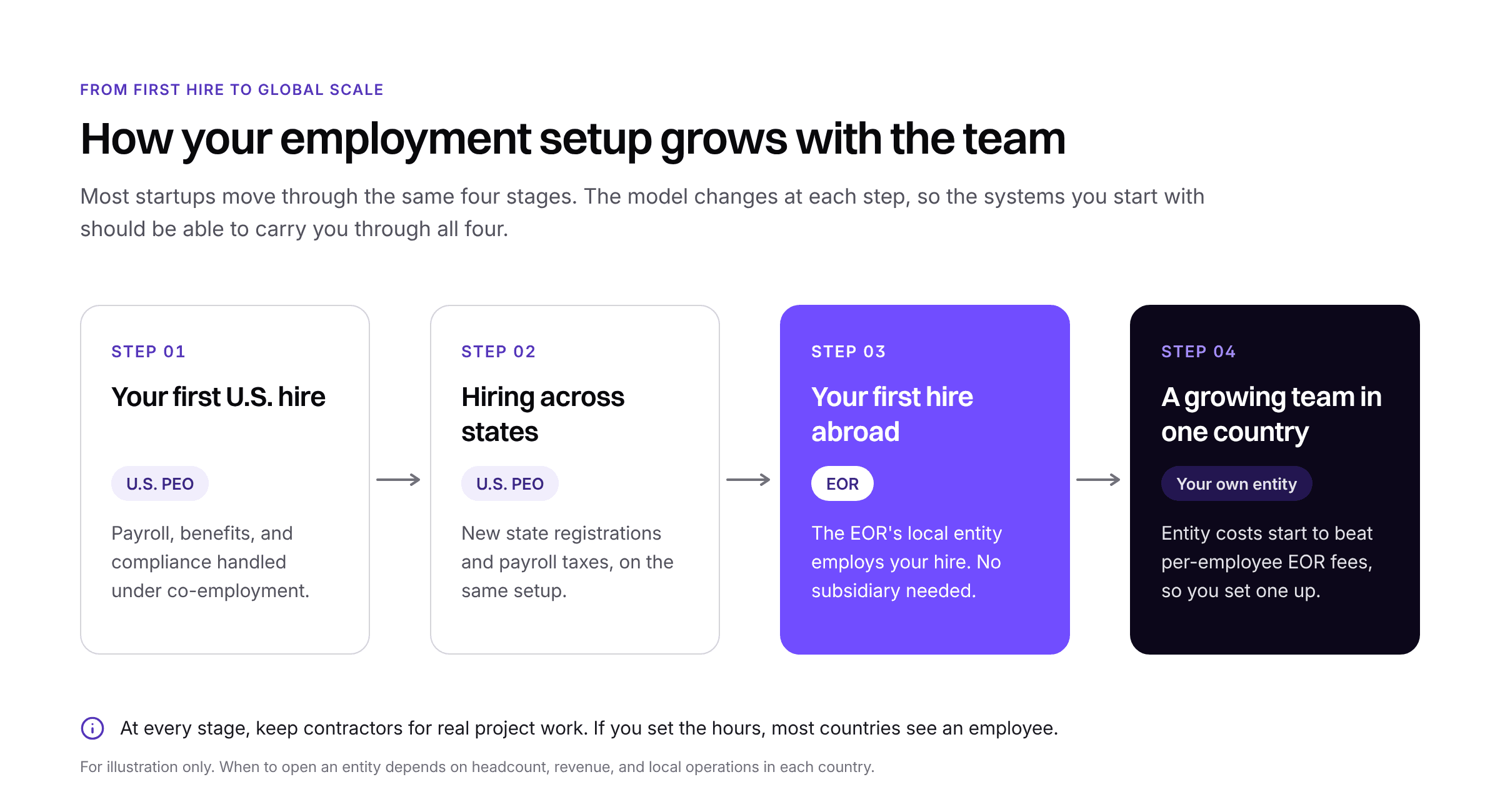
The company can hire via PEOs where it has no entity at all and then run a country conversion process to move the teams onto its own entities as it grows. That sequence is the typical one for most startups.
- Use contractors only for the actual project work.
- Use an EOR for your first hires in a new country.
- Set up an entity when the headcount, revenue, or local operations in that country are such as to justify it.
A global PEO has the entity, the payroll accounts, and the local filings all in place. That's what you pay for when you've got a small team in a country.
Get the infrastructure right on your first hire
Niural is an AI-native PEO. Starting there matters because the systems you choose for your first U.S. hire are the ones you'll still be running when you hire in Lisbon, and rebuilding payroll, classification, and employee records mid-growth is slower and riskier than setting them up well once.
On the U.S. side, Niural PEO covers payroll, benefits, and compliance under co-employment. EMMA, Niural's AI layer, validates payroll before the run, flags missing rate changes, and flags potential misclassification risk, so problems surface before anyone gets paid.
When you hire abroad, Niural's EOR covers 150+ countries on the same platform. Your US staff, your international staff, and your contractors are all in one place from your first hire to global scale, and a new country is just an extension of the setup you already have.
If your first international hire is on the calendar, then take a look at how Niural's EOR works.
Other related articles:
PEO vs. Payroll Service
PEO vs EOR vs Staffing Agency
PEO vs Employee Leasing
How to save on benefits with a PEO
Top 5 compliance mistakes financial leaders can eliminate with a PEO.
Frequently Asked Questions
Is an international PEO the same as an employer of record?
Yes, international PEO, EOR, and global employment organization all describe the same thing: a provider who will legally employ your staff overseas via its own local entity, and you will be in control of their work.
Can a U.S. PEO employ someone in another country?
No, a U.S. PEO co-employment covers people working in the US. If you're outside the US, you'll need an EOR or your own registered entity in that country.
Who is the legal employer when I use an EOR?
The EOR's local entity. It's the one that signs the employment contract, handles the payroll, and files with the local authorities. Your company will be the one directing the employee's work under a service agreement with the EOR.
Do I need a foreign entity to hire someone overseas?
Not if you use an EOR. The EOR will have the entity in place so you can make an offer without having to register a company, open a local bank account, or set up your payroll tax accounts.
Can an EOR sponsor a work visa?
Occasionally. It varies from country to country and from provider to provider. You need to confirm sponsorship prior to making an offer to someone who doesn't already have the right to work in that country.
Who owns the IP that my EOR employee creates?
Your company should, provided, of course, that the contracts so provide. You need to ensure that both the EOR's employment contract and your service agreement assign the IP to you and have legal counsel check the local rules.
Does an EOR eliminate the risk of permanent establishment?
It reduces employment-related exposure but doesn't settle tax residency questions. What the person does matters, especially signing contracts or selling locally. Ask a tax advisor about senior or revenue-facing hires.
What does an EOR handle on a monthly basis?
Local payroll, income tax withholding, employer social contributions, statutory benefits, extra-salary payments such as Brazil's 13th salary, and filings with local tax and social security authorities.
Should my very first international hire be a contractor or an employee?
It depends on the working relationship. If you set the hours, provide the tools, and the work is core to your business, most countries will treat that person as an employee.
Disclaimer: This article is for informational purposes only and does not constitute legal, tax, or employment advice. Employment, tax, and social security rules vary by country and change often. Consult qualified advisors before hiring in a new country.