Key takeaways
- Each employee who works in another state will normally have that state's withholding and unemployment insurance accounts added to your payroll.
- One full-time remote employee in a new state will generally create a withholding obligation in that state, and unemployment insurance will almost always follow the state where they are physically working.
A lot of founders come across the multi-state payroll issue in exactly the same way. A very good candidate in Denver takes the job, the payroll account gets set up in California, and a few weeks down the track you get a letter from a state agency asking you why you've never registered.
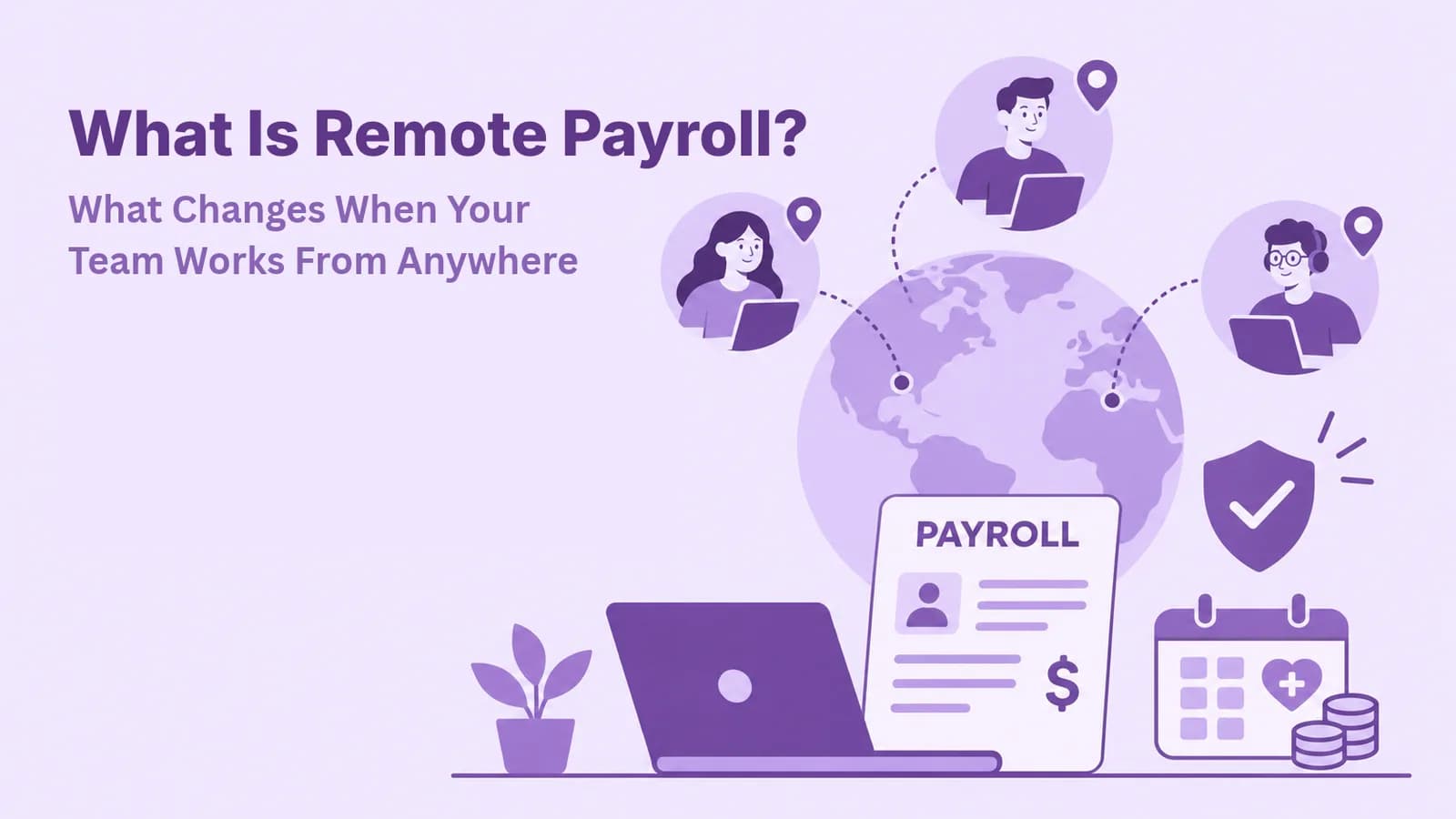
Remote payroll is the process of paying your employees, withholding the correct amount of tax, and filing on their behalf when they work remotely rather than at your registered office. In March 2026, 22.6% of U.S. workers were teleworking or working from home for pay (BLS).
The rules follow each employee's work location, which can be a state your company has never registered in. That makes the first hire the cheapest moment to build payroll infrastructure properly, on an AI-native system that checks each run before it goes out, and before a second or third state shows up.
What does it mean to pay the wages of remote workers?
Payroll for remote employees is the same basic stuff as office payroll: gross pay, federal income tax, FICA (Social Security and Medicare), benefit deductions, and the various filings. Each state where someone works can then add on its own income tax withholding, unemployment insurance account, local taxes, and pay rules.
Obligation | Everyone in one office | Team spread across states |
State registration | One state | Each state where an employee works, usually before the first payroll there |
State income tax withholding | One state's rules | Each work state's rules, plus convenience-rule and reciprocity exceptions |
State unemployment insurance | One account | Generally the state where each employee physically works |
Local taxes | One city or county, if any | Depends on each employee's address |
Pay rules | One state's minimum wage, pay frequency, and final-pay rules | Each work state's rules |
Form W-2 | One state section | A state section for each taxing state |
The federal side is unchanged. You pay and report your federal employment taxes to the IRS on one schedule regardless of where your employees reside.
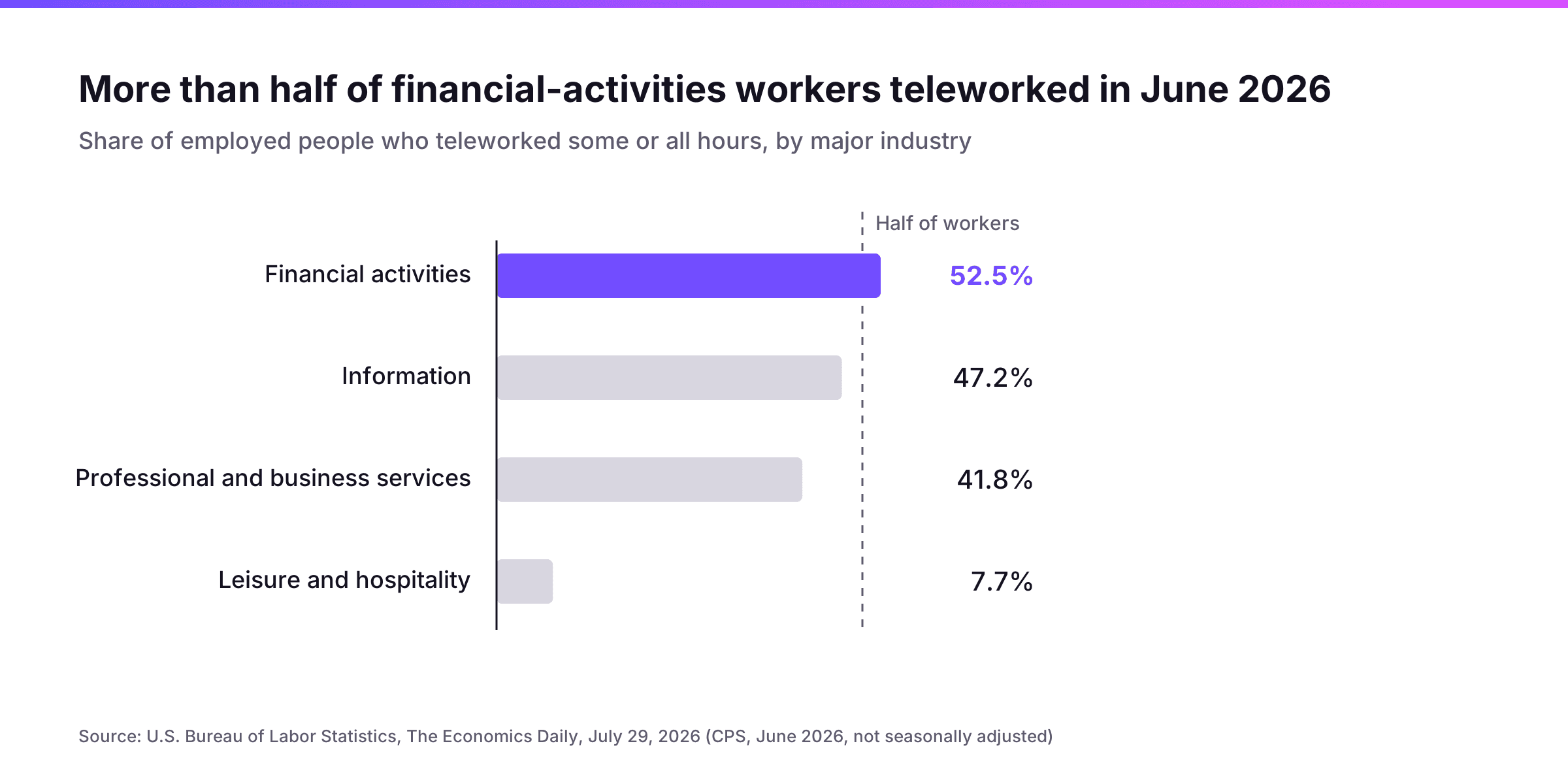
Remote working is also most prevalent in the sectors that are home to so many start-ups. In June 2026, over half of the workers in financial activities were working from home, as opposed to fewer than 1 in 10 in leisure and hospitality.
Why should founders be building payroll infrastructure at the first hire?
Payroll gets progressively harder in a very predictable sequence. The first hire generates a pay run. The first out-of-state hire brings in a second set of state accounts. A contractor comes along and raises a classification issue. Then someone wants to hire in Portugal. The companies that start with a basic tool will tend to just add on another vendor to patch each stage, and the errors accumulate in the gaps between the tools.
Niural is AI-native payroll built for the entire path. Its AI layer (EMMA) validates the payroll prior to the run and flags any missing rate changes so you catch the issues before any money moves.
Two more details matter to a founder watching cash and planning growth:
- Payroll funding balances held in the Niural Wallet accrue cash rewards* until payday, so working capital isn't just sitting around between the funding and the pay date.
- The same platform handles U.S. payroll, PEO, EOR in 150+ countries, and contractor payments so you’re on one platform from first hire through to global scale.
What does one out-of-state hire set off?
A single full-time remote employee in a new state will generally create a withholding obligation in that state. Prior to that employee's first paycheck, you'll normally need to:
- A state income tax withholding account with the state's revenue department, unless the state has no individual income tax (Alaska, Florida, Nevada, New Hampshire, South Dakota, Tennessee, Texas, Washington, and Wyoming)
- A state unemployment insurance (SUI) account, which applies in those nine states too
- Foreign entity registration with the secretary of state, where the state requires it
- Local tax accounts if the employee's address falls inside a taxing city or county
- A new-hire report to the state's directory
SUI is sourced under the federal four-factor "localization of work" test, so it will almost always go to the state where the employee works (physically), even if the income tax goes somewhere else. An employee can create their income tax return in one state and their SUI return in another.
Why do some states tax remote workers who never set foot in the office?
Most states tax wages on the basis of where the work is physically performed. A few states opt for the "convenience of the employer" rule instead. Under that rule, the days of remote work are attributed to the state in which the employer's office is located, unless the employee is working remotely because the employer needs them to. New York is the most stringent in its application of the rule. Pennsylvania, Delaware, Nebraska, and Arkansas all have their own versions. Connecticut and New Jersey have reciprocal versions which only apply to residents of states that have the rule.
The best-known test case is Edward Zelinsky, a Cardozo Law School professor in New York City who lives in Connecticut. He challenged New York's tax on his home-office days, including days during the COVID-19 shutdown when his office was closed. On May 15, 2025, New York's Tax Appeals Tribunal ruled against him. His first challenge, over 1994 and 1995 taxes, failed at New York's highest court in 2003. The Tribunal wrote that "the nature of the employment relationship is paramount."
With remote payroll, that means the state your employee lives in may not be the only state you're liable to withhold for. A New York company whose New Jersey engineer comes into the office from time to time is going to be liable to withhold for New York on the home days as well.
What does a payroll tax error cost?
Remote teams don't alter the federal deposit rules. What's happening is that more and more states and more and more people are making it easier to miss deadlines. The IRS does impose a failure-to-deposit penalty, which increases as the deposit is later, ranging from 2% to 15% of the amount that's not deposited.
How late | Penalty (% of unpaid deposit) |
1 to 5 days late | 2% |
6 to 15 days late | 5% |
More than 15 days late | 10% |
10+ days after IRS notice | 15% |
Source: IRS, Failure to Deposit Penalty (irs.gov), accessed October 2026
The tiers simply replace one another rather than compound, so a deposit 20 days late will attract a 10% penalty. The states will, of course, impose their own penalties and interest on top of the federal amounts.
How do you set up payroll for a remote team?
- Record each employee's work location, not just their mailing address, and update it when someone moves.
- Register for withholding and SUI in each work state prior to the first payroll.
- Check convenience rule exposure if your office or any of your employees are in New York, Pennsylvania, Delaware, Nebraska, Arkansas, Connecticut, or New Jersey.
- Look at the reciprocity agreements, which allow some employees who live in one state and work in an adjacent state to pay income tax only to their home state.
- Apply the pay rules for each work state (minimum wage, pay frequency, and timing of final pay).
- Reconcile the state filings each quarter and re-check the registrations whenever anyone moves.
With employees in two or three states, or anyone in a convenience-rule state, that list outgrows a spreadsheet. That's when remote payroll services earn their cost. They handle state registrations, multi-state withholding, and filings, and the better ones check payroll before it runs.
Remote payroll is easiest to get right when you're still small. If your next offer letter is going to someone in a new state, then get the accounts set up before their first day and pick a system that will still work when your next hire is in another country.
See how Niural handles payroll from first hire to global scale.
Other related articles:
Multi-state payroll
Payroll taxes explained
1099 vs W-2 classification rules
Payroll reconciliation
EOR vs. entity setup
Frequently Asked Questions
What is remote payroll?
Remote payroll will pay, withhold taxes, and file on behalf of employees who work outside of your company's registered office state. It will cover the federal taxes as well as the state and local taxes of each state in which the employee works.
Do I need to register in a state if I have one remote employee there?
Generally yes. One full-time employee working in a state will normally require a state withholding account (if the state has income tax) and a state unemployment insurance account prior to their first payroll in that state.
Which state's income tax do I withhold for a remote employee?
Usually the state where the employee physically works. The main exceptions are convenience-of-the-employer states, which can tax home workdays to the office state, and reciprocity agreements, which let some cross-border commuters pay only their home state.
Where do I pay the unemployment insurance for a remote employee?
Generally in the state where the employee physically works. SUI follows the federal four-factor localization test, which is separate from the rules for income tax withholding.
Which states use the convenience of the employer rule?
NY, PA, DE, NE, and AR all have versions of it. CT and NJ have reciprocal versions in place for residents of states that have the rule. Always check with the individual state's revenue department to confirm what the current rules are.
Do states with no income tax still require payroll registration?
Yes, Alaska, Florida, Nevada, New Hampshire, South Dakota, Tennessee, Texas, Washington, and Wyoming don't tax wages, but employers with workers in those states will still have to register for state unemployment insurance.
What happens when a remote employee moves to another state?
Update their work location, register in the new state prior to their next payroll, and split that year's wages between the two states on their Form W-2. Then close or update the old state accounts.
What is a state reciprocity agreement?
It's an agreement between two states whereby a resident of one state who works in the other can pay income tax to their home state only. The employee would normally complete an exemption form with their employer.
What's the IRS penalty for late deposit of payroll taxes?
The failure-to-deposit penalty is 2% if the deposit is 1 to 5 days late, 5% if it's 6 to 15 days late, 10% if it's more than 15 days late, and 15% if it's still not paid 10 days after the IRS issues a notice.
When should a startup use remote payroll services?
Once you have employees in more than one state, or anyone working in a convenience-rule state. At that point, registrations, multi-state withholding, and filings are hard to track by hand.
Can AI help with payroll for remote workers?
Yes, for checking work before money moves. Niural's EMMA validates payroll before the run and flags missing rate changes, so errors get caught before they turn into corrections or penalty notices.
Disclaimer: This article is for informational purposes only and does not constitute legal, tax, or payroll advice. State and federal requirements change and depend on your specific facts. Consult qualified tax, legal, and payroll advisors before acting. Information is current as of October 2026.
* Niural is a financial technology company and is not a bank. Banking services are provided by i3 Bank, Member FDIC